3 Ways to Remove Himalayan Blackberry in Portland, Oregon
Himalayan Blackberry thrives in the rainy Pacific Northwest and, if left unchecked, will take over our property and ornamental plants. If you’ve ever found yourself entangled in a thicket of
blackberry thorns, we’re sure you agree with the sentiment that they should be scorched from the face of this earth.
On a serious note, before you head out to start hacking away, let’s talk about how to identify the non-native, invasive plant species known as the Himalayan blackberry “Rubus armeniacus” or “rubus discolor.”
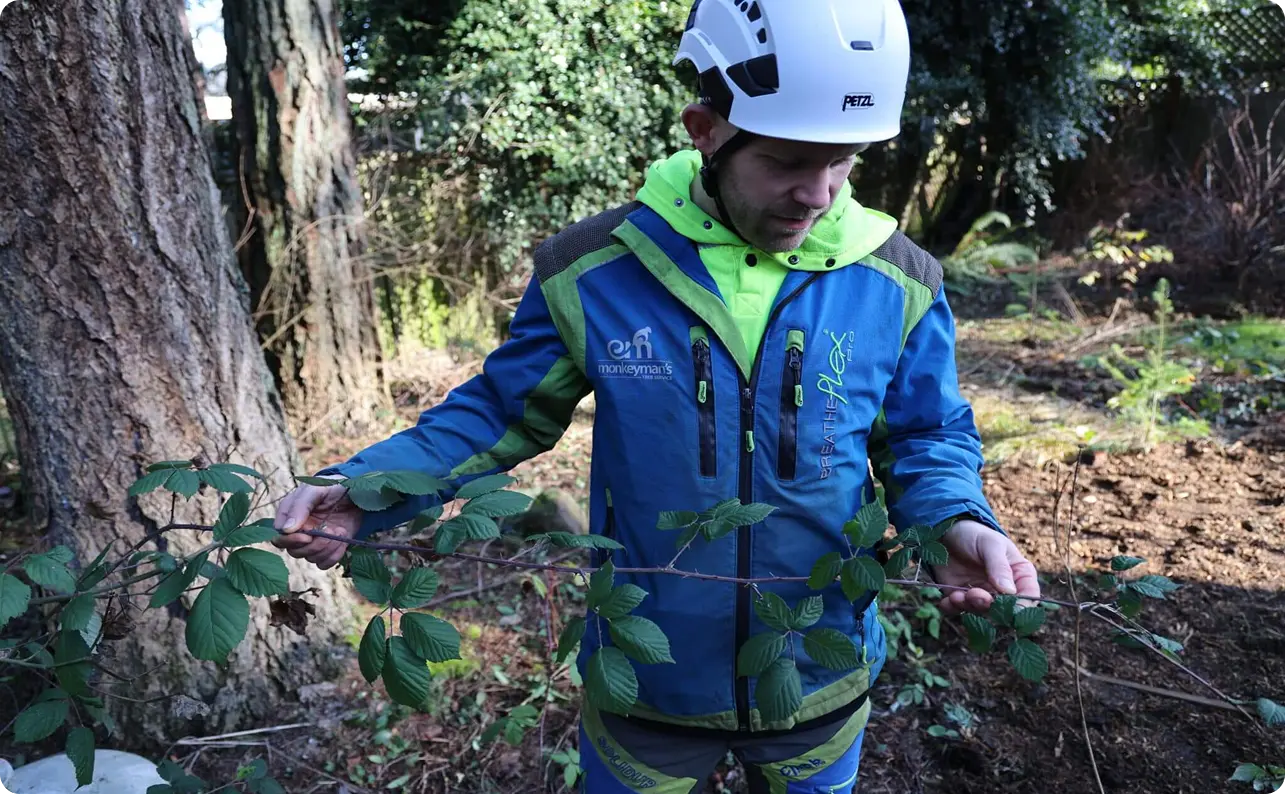
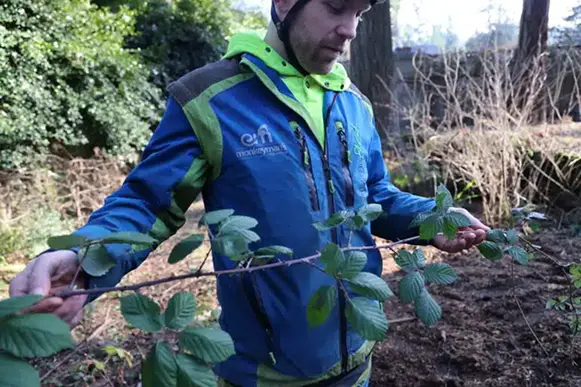
The Oregon Department of Agriculture provides a noxious weed list that includes Himalayan blackberries, which almost always have five leaflets with a red vine covered in thorns.
Blackberries are a member of the rose family and produce white flowers that turn into tasty black fruit in the Summer months in Oregon – but don’t let this fool you! The Himalayan Blackberry also takes a toll on the environment around it.
Invasive Blackberries’ Native Look-alike
Most people don’t know that in the Pacific Northwest, there is a native blackberry often called ‘Trailing Blackberry’ or ‘Dewberry’ (Rubus Ursinus). This native berry lives as a ground cover in forests and does not grow into large, overwhelming thickets with the same vigor that the Himalayan variety would. It has a blue-to-white stem compared to the bright red stem of the Himalayan blackberry. The berries are almost identical, although the native blackberry almost always has three leaflets compared to five. For more information regarding native and non-native trees to plant in the Portland area check out our blog post titled “Native and Non-Native Tree Planting Options in Oregon.”
Growth Habits and Biology of Himalayan Blackberry
Landscape Architect and Horticultural Professor at the University of Oregon, Whitey Lueck, has described the growth habits of the Himalayan blackberry as: “If left uncontrolled, Himalayan can take over a field. This is because of its fast-growing canes that can grow up to 30 feet long over a single growing season and re-root themselves the following fall.” This relentless growth impedes the native plant’s ability to germinate and thrive. For example, native conifers like Douglas-fir, require sunlight for germination and survival as a sapling.
Unfortunately, Himalayan Blackberry creates dense thickets in the forest’s
understory, which can shade out native flora. Native birds and omnivores, like foxes and bears, also favor their delicious berries. which aids the ever-reaching spread of this invasive weed into untouched territories, making eradication a constant and laborious process. The Himalayan blackberry desires full sun and without it, its growth and fruiting are slowed. We can use this to our advantage to gain control over the spread, by planting and maintaining a shaded canopy of conifer and evergreen trees and native shrubs.
3 Techniques For Blackberry Removal
Digging
You may wonder, how do I permanently remove blackberry bushes? We have found, over the years, that the most effective and environmentally friendly alternative to using a hash herbicide is to dig up the roots – specifically the large root crowns. Although this is quite labor intensive, it ensures that the hardy blackberry plant won’t sprout back from the root crown. This method is supported by repeated mowing or herbicide over a period of years, however, we believe it to be the most effective manner of eradicating the blackberries long-term. We recommend planting evergreen hardy natives after removal. Natives can help provide aesthetic value as well as assist in deterring invasive blackberries long term